Governance architecture first, tool selection follows
 By
By
The regulated life sciences industry has never invested more in digital validation tools, and it has never had more of them to choose from. Procurement budgets are climbing. Vendor demonstrations dominate quality conference agendas. Adoption curves for computerized validation platforms move in one direction.
Data integrity gaps remain a persistent thread in FDA warning letters. Those two facts should not sit comfortably next to each other in an industry that has spent over a decade digitizing its validation lifecycle.
Most digital validation implementations solve the wrong problem first.
They digitize the evidence collection. They automate the documentation. They accelerate the artifact generation. The governance architecture that determines whether any of that evidence, documentation, or generated artifact produces the assurance outcome GxP compliance requires stays untouched.
A digital validation tool configured without a decision quality framework governing its workflows produces a digital record of the same governance gaps that made the manual program inadequate. Now archived faster, at greater scale, behind an interface polished enough to hide those gaps until an auditor finds them.
Optimizing the GxP system validation lifecycle with digital tools starts with a sequencing discipline most implementations skip entirely. Governance architecture comes first. Tool selection follows from it.
A platform exposes what was already broken
A platform exposes whether a validation lifecycle was ever designed to be optimized in the first place. Organizations that digitize a lifecycle built on manual, document-centric processes get a faster, larger version of the same inefficiencies, the same decision quality deficits that made the manual program inadequate.
The sequencing principle most implementations violate
A digital validation platform configured without a clear decision quality model governing its workflows, evidence standards, and change control requirements accumulates configuration debt at the same rate as the manual program it replaced. It produces tool-generated documentation that satisfies a compliance obligation on paper. The assurance outcome that obligation exists to require never shows up. Governance architecture has to precede tool selection, because every workflow the tool configures is a decision, and an unconsidered decision does not become defensible because it was made faster.
Continuity is the metric, not completion
Organizations that have optimized their GxP validation lifecycle share one characteristic. They measure success in a continuously maintained, permanently audit-ready validated state. Audit preparation stops being a periodic sprint. It becomes an ongoing capability. The digital tools generate assurance evidence at the same moment the system is in use.
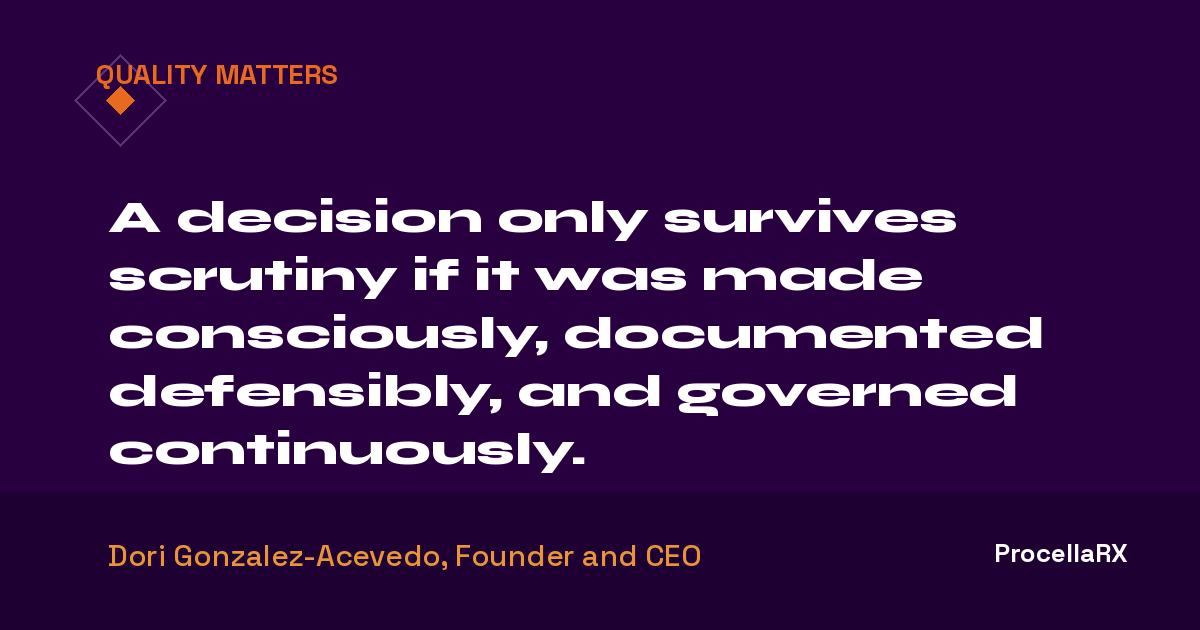
This is the same argument underneath Decision Quality Intelligence: a decision is only worth trusting when it is conscious, defensible, and continuous. Digital validation tooling is not exempt from that standard. It is the place the standard gets tested hardest, because a platform can produce the appearance of governance at a speed and scale manual processes never reached.
If your organization measures its digital validation investment by how much of the process is now digital, that is the wrong number. Measure it by how continuously audit-ready the system stays.