Elevation Isn’t a Brake on AI. It’s How a Critical “Yes” Gets Made Responsibly.
 By
The pharmacist was always the first line of defense. Responsible AI lessons from OpenText World 2026, through a pharmacist’s eyes.
In my last post, I wrote about a patient who asked an AI chatbot whether to stop a medication and followed the answer.
Before AI, that question would most likely have been asked at a pharmacy counter. That’s not an accident. Pharmacists consistently rank among the most trusted professions in America; Gallup’s latest Honesty and Ethics poll (December 2025) puts pharmacists fourth of 21 professions. That trust is earned in a specific way. When a patient asks, “Can I stop taking this?”, a pharmacist does four things an unchecked AI answer does not:
- Checks the question against the full picture: the patient’s profile, other medications, history and the prescriber’s intent.
- Knows which decisions are not theirs, or the patient’s, to make alone. Some medications must never be stopped without the treating physician’s consent.
- Elevates. The pharmacist calls the prescriber, brings the right authority into the decision, and doesn’t let it happen by default.
- Records. The intervention is documented so the next member of the care team knows what was decided, by whom, and why.
None of this is about saying no. A patient who wants to stop a medication usually has a real reason: side effects, cost, a life change. A good pharmacist doesn’t block that request. They define an informed, safe path to an appropriate “yes”, whether that’s a supervised change, an alternative therapy, or a conversation with the prescriber that leads to a better plan.
When a patient goes straight to an AI for the answer, all four steps disappear. The answer is faster. The first line of defense, and the safe path to yes, is gone.
In regulated industries, the Quality function is the pharmacist. It’s the trusted first line of defense that checks, elevates, records and works with the team. It isn’t the department of “no”; it’s the function that makes “yes” safe, informed and defensible.
Both exist for the same reason. A pharmacist’s checks aren’t about paperwork; they’re about the person at the counter. A quality management system isn’t about audit theater, reports or process for its own sake; it exists to protect public health and patient safety. That’s also the purpose of Decision Quality Intelligence (DQI), the framework we built at ProcellaRX: every quality decision must be conscious, defensible and continuous, because a patient is always on the other end. The pharmacist, the Quality function and DQI are three expressions of one commitment: patient safety.
As I wrote that post, I kept hearing echoes of OpenText World 2026 in Orlando a few weeks earlier. Session after session, leaders described this same lesson in enterprise language. The encouraging part: today’s modern validation and quality tools are increasingly building these decision requirements in by design. Here are the lessons, and what responsible AI looks like when you keep the Quality Expert in the loop.
1. An unchecked answer is a fast wrong answer
OpenText CEO Ayman Antoun described the gap between a person and an AI agent. A person who sees data that doesn’t add up will pause, question it and ask a colleague. An agent won’t:
“It will take the data, it will reason at machine speed, and you get an incredibly fast wrong answer.”
The pharmacist’s value has never been speed. It’s the check.
DQI lesson (Defensible): speed is a property of the tool; defensibility is a property of the decision. If Quality can’t see and verify the basis for an AI-assisted outcome, it isn’t a decision. It’s an output.
2. The first line of defense needs the full patient profile
Antoun called trusted context and connected data the “oxygen” of the enterprise AI stack: “The only way… this works is when you’re feeding the body oxygen.”
A pharmacist is trusted because they see the whole profile, not just the question. An AI answering in isolation, about a patient or a batch, sees a fragment. Lloyd Adams, COO of Global Enterprise Sales at Microsoft, was direct about what that means for governance:
“Trust can’t be added after the AI work is done.”
DQI lesson (Defensible): give the Quality function, and any AI it relies on, connected context by design. Data integrity, lineage and access are inputs to the decision, not findings after the fact.
3. Elevate every critical decision, and record it defensibly
Andrea Baptiste, ISV Business Leader at AWS, said client conversations have shifted from “how fast can we pilot?” to “how do we get to production?” Her answer was accountability and traceability:
“Who is accountable for those decisions? And how do you trace how that decision came about?”
OpenText’s own Global Command Center showed what elevation looks like in practice. In 30 minutes on stage:
- 90 events came in.
- 50 became alerts.
- 45 were transient noise.
- 5 became incidents elevated for human action.
In a related showcase, an incident-prevention scenario ended the same way: the system found a likely root cause and proposed a fix, then sent it to a specialist for approval before anything changed.
That’s exactly what a pharmacist does with a risky request. They don’t refuse to engage, and they don’t decide alone. They elevate, they write it down, and the patient gets to an answer that is safe. That’s the whole point: elevation isn’t a brake on the AI. It’s how a critical “yes” gets made responsibly.
And writing it down is not the same as defending it. There is a difference between a documented closure and a defensible one. A defensible record shows why the decision was right, not only that it was made.
DQI lessons:
- Conscious: define your critical decisions up front. These are the ones that always go to the accountable authority.
- Defensible: every elevated decision carries its record of what the AI proposed, what context was reviewed, who approved and why.
4. Care teams work as a team, and so do humans and AI
Care teams work best when they’re given the opportunity to work as a team: patient, pharmacist, physician, nurse, each with a role. The risk with AI isn’t that it joins the team. It’s that it’s used to skip the team.
Shannon Bell, EVP & Chief Product & Technology Officer at OpenText, returned to one idea throughout her keynote:
“AI is a team sport… we cannot do it alone.”
Shaney Salomon, CEO of Optima ECM Consulting, described how that works between partners: “coming in as one team from the beginning… from day one.”
The combination of people and technology can hold the conditions for good decisions at scale. It does not replace the human judgment those conditions exist to support.
DQI lesson (Continuous): design AI into the team, with defined roles, hand-offs and escalation paths across Quality, Operations, Validation and IT. Don’t design it as a shortcut around them.
5. Make the safe path the easy path
The breakout I’d send every quality leader to was Catalent’s account of harmonizing manufacturing documents across 40+ sites. Erik Dustrude described building systems, so the compliant choice is the easy one:
“You want to make it impossible for your users to make the wrong choice. You want to make it very easy for them to make the right choice.”
He called it bumper bowling. Notice what it isn’t: a wall. Bumpers don’t stop you bowling; they keep the ball on a path that scores. Pharmacy has worked this way for decades, with interaction checks, required counseling and prescriber verification, all designed to get patients to “yes” safely. And Megan McFarland, VP of IS Operations at Ochsner Health, added the discipline many AI programs skip:
“Before we jump to an AI solution, is there an automation opportunity that we can use?”
DQI lesson (Conscious): reserve AI for genuine judgment and put guardrails around it. Deterministic, validated automation is often the more defensible first step.
6. Tools enforce the record. People decide what is critical.
The most encouraging echo from OpenText World: these decision requirements are no longer just policy on paper. They’re becoming features of the tools.
Catalent showed the pattern in its Documentum deployment across 40+ sites:
- approval workflows with built-in pause points;
- a two-person verification check enabled by default;
- mandatory contemporaneous sign-off;
- custom queries that show, at any moment, what’s open and what’s closed.
The guardrail is in the system, not in someone’s memory.
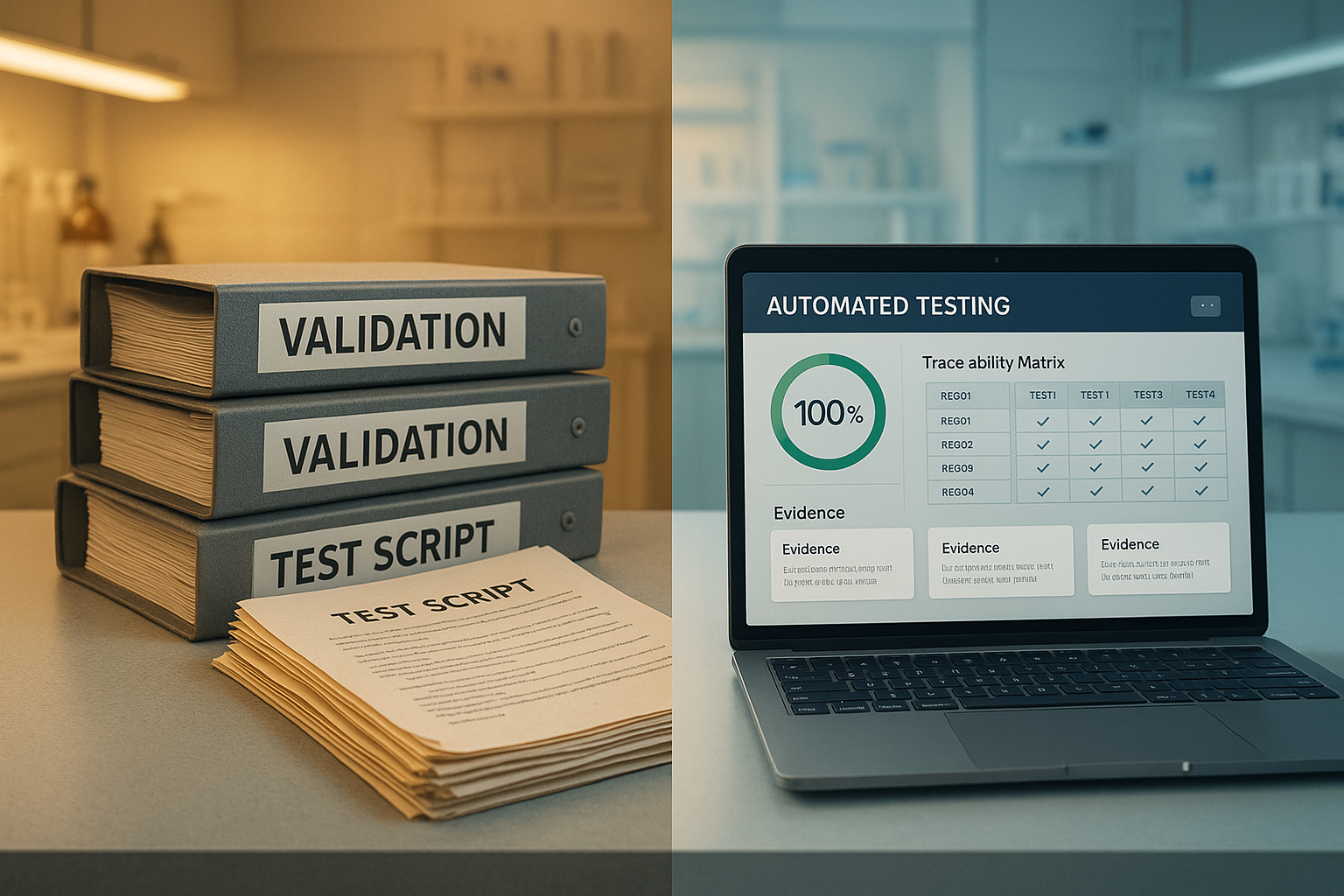
The validation community is moving the same way. In the 2026 State of Validation report (614 validation professionals; independently authored, powered by Kneat), better traceability ranked as the top benefit of digital validation for the first time, ahead of data integrity. Respondents named continuous audit readiness alongside it as the benefits they value most.
The same survey drew a clear line on AI. 53% of respondents accept AI drafting or summarizing with mandatory human review. Only 16% accept AI making or changing GxP decisions without human approval. The tools and the professionals are converging on the same answer: AI speeds up the path; the accountable human approves the “yes.”
But a tool only enforces what someone defined. It will route, record and trace whatever it is pointed at. Point it at the wrong decisions and it produces a perfect record of things that don’t matter. Deciding which decisions are critical, who owns them and what must be proven remains a human act.
DQI lesson (Continuous): build decision requirements into the platform so they don’t depend on individual memory. Then keep the definition of what is critical, and who approves it, with an accountable person in Quality.
The point was never the paperwork
It’s easy to forget why any of this exists. Validation packages, approval routes, audit trails and traceability matrices can start to feel like the job itself. They aren’t. They’re how we show, to ourselves, our inspectors and the public, that every critical decision protected the patient.
That’s the test for AI in a quality system. Not “is it faster?” and not “will it pass the audit?”, but “does it make the decision safer for the patient who will take this dose?” A pharmacist asks that question every day without thinking twice. Responsible AI, and DQI, ask the same question by design.
Keep the pharmacist in the loop
Before AI goes into your quality system, ask what a good pharmacist would ask, with the patient in mind, and check whether your tools enforce the answer:
- Is this a critical decision? If so, it’s elevated. Always.
- Who is the accountable authority? Name the role in Quality, not the system.
- Does the decision-maker see the full profile? What context is the AI missing?
- Is it defensibly recorded? Proposal, context, approval and rationale, all traceable.
- Is the team in the loop? Defined hand-offs, defined escalation, no shortcuts.
ExxonMobil’s Jessica Faddis put it simply on the main stage:
“Human expertise and oversight are always going to be required.”
AI will make us faster. The first line of defense is what makes us right. Responsible AI isn’t about saying no. It’s about defining an informed, safe path to an appropriate “yes.” A fast wrong answer is still wrong, and in our industry, someone always takes the dose.
The pharmacist, the quality system and decision quality were never about the reports. They were always about the patient.
Conscious. Defensible. Continuous. For patient safety. Keep the pharmacist in the loop.
#DecisionQuality #DQI #ResponsibleAI #GxP #QualityAssurance #Pharmacist #PatientSafety #DigitalValidation #OpenTextWorld #LifeSciences
References
1. Gallup. “Nurses Continue to Lead in Honesty, Ethics Ratings.” January 12, 2026. https://news.gallup.com/poll/700736/nurses-continue-lead-honesty-ethics-ratings.aspx
2. OpenText World 2026, Orlando, FL. Day 1 Keynote: “Open Foundations & Open Innovations: Context, Connected Data and the Agentic Enterprise.” October 20, 2026. Speakers quoted: Ayman Antoun, CEO; Shannon Bell, EVP & Chief Product and Technology Officer, OpenText. On-demand sessions: https://www.opentext.com/resources/opentext-world#videos
3. OpenText World 2026. Day 2 Keynote: “Open Horizons & Open Partnerships: Turning AI Ambition into Business Value.” October 21, 2026. Speakers quoted:
◦ Andrea Baptiste, ISV Business Leader, AWS
◦ Lloyd Adams, COO, Global Enterprise Sales, Microsoft
◦ Shaney Salomon, CEO, Optima ECM Consulting
◦ Jessica Faddis, Lease Management & GIS Manager, ExxonMobil
On-demand sessions: https://www.opentext.com/resources/opentext-world#videos
4. OpenText World 2026. Product Showcase session (IT Operations Management): “You don’t have an AI problem. You have a control problem. Make agentic IT operations work at scale.” October 20, 2026. Speaker quoted: Megan McFarland, VP IS Operations, Ochsner Health. On-demand: https://www.opentext.com/resources/opentext-world#videos
5. OpenText World 2026. Breakout: “Scaling digital cGMP: How Catalent standardizes manufacturing documents across 40+ sites.” October 21, 2026. Speaker quoted: Erik Dustrude, Business Process Manager, Catalent. Presented in session.
6. Kneat (kneat.com, inc.). 2026 State of Validation study, press release, April 30, 2026. Kneat-sponsored survey of 614 validation professionals. https://www.nasdaq.com/press-release/2026-state-validation-study-reveals-significant-headroom-remai…